Music for Virtual Events: What’s the Point?
Go to YouTube now and watch the video titled ‘Jaws with and without music’ in which you will see three brave shark hunters luring Jaws around their boat out in the ocean. Without music the scene is dramatic but with John Williams’ score it is enhanced tenfold. It is the contrast within this music that illustrates the drama unfolding. When the shark heads towards the boat, we hear a threatening, pulsing motif in a minor key; the fish is the villain. Once the shark has been tagged with a barrel, the musical theme becomes positive and triumphant in colour in a major key with a trumpet fanfare; we know our protagonists are winning! This is a great example of the power of music to elevate and intensify our experience of the world.
Starting with Descriptive Keywords
When selecting music to complement and illustrate events hosted by OpenExchange for its clients – and any other companies or brands – we start with descriptive keywords that describe the aesthetic and the message: connection, corporate, technology, community, futuristic, visionary etc. A good example is the music chosen by our news channels. Let’s start with the theme for BBC News which is based on the Greenwich Time Signal (more affectionately known as the ‘pips’), composed in 1924. The pips were added to mark the precise time of each hour before the headlines are announced, and are still in use today.
More recently David Lowe built an electronic dance-style music track around these pips that is futuristic and drives forward with exciting momentum. As a listener – whether you are listening actively or passively – you feel the theme’s steady rhythm and momentum. It conjures up a radio tower signal, beaconing out for the whole community and connecting us all. We understand instantly that the broadcast we are about to watch is organised, punctual, current and important. The use of Lowe’s fresh musical arrangement of the pips connects the listener to something familiar, trust-worthy, comfortable and so ingrained in British psyche that there is an unconscious acceptance of the BBC news starting.
NBC news, however, sought to avoid the synthesised sounds that were becoming commonplace across US networks, instead consciously standing out with an orchestrated theme. They tasked John Williams to write The Mission Theme in a brief requesting dignity, pride and consistency. Have a listen to the NBC theme and you will also hear majesty, sophistication and – perhaps most importantly – positivity. Positivity is particularly interesting as so often the news is predominantly not positive. NBC’s music therefore leaves us with a feeling of hope. It’s a hope that the world will overcome its difficult headlines, and that as a community we are united in our experiences and efforts; however bad the news is, a great new dawn is possible. This huge dose of carpe diem we receive whilst pouring our morning orange juice makes us confident that we will triumph in our endeavours of the day ahead!
Music for Virtual Events
Just because OE is (probably) some way off delivering global news(!), doesn’t mean these principles aren’t directly applicable to the world of virtual conferences. There are elements to OE virtual events which make specific demands on any music. Waiting rooms and holding slides requiring music need to loop seamlessly and be unobtrusive yet atmospheric. The 15-second countdown to a keynote speech must be the opposite; engaging and finite in length.
Any piece of music – great or small – has the potential to be brand-specific. With multiple events booked into the months and years to come, who could refute the strength musical consistency can bring to elements of a virtual events. Many of OE’s biggest clients have existing sonic libraries, from which material can be manipulated and re-composed for the specific requirements of these events. Just as everyone in the UK has become accustomed to the pips of BBC news (first heard almost 100 years ago), who, globally, doesn’t know the four-note Intel jingle? Familiarity and repetition are incredibly powerful.
Licensing and Permissions
Now for the T&Cs. It won’t come as any surprise that there can be significant hurdles to the use of existing recorded music. Licenses, written permission, and financial costs are all part and parcel with a lot of existing material. Even good counsel and deep pockets won’t get you that hippy-rocker’s permission to use their song for an event promoting fossil fuels.
Aside from a number of subscription services to license-free music (think Getty Images but for music), a couple of enterprising companies and record labels are seeing the need to make music more easily available. Hipgnosis has burst onto the scene as a whole new creation, buying out artists’ entire back-catalogues and making them available on a per-track or subscription basis. Orchid Classics is at the forefront of classical music labels in offering its entire catalogue on a similar model to Hipgnosis. OE is proud to be partnering with both organisations to offer a comprehensive catalogue of some 160,000 tracks spanning every conceivable genre.
Music has extraordinary power. The skill is not simply knowing that a keynote showcasing a new Krispy Kreme flavour combination requires something different to a keynote on the fallout of Brexit. Nor is it enough to know the difference between Britney Spears and Beethoven. All of the above are but a few of the ingredients in a sophisticated recipe, with phenomenal power when deployed sensitively and appropriately.
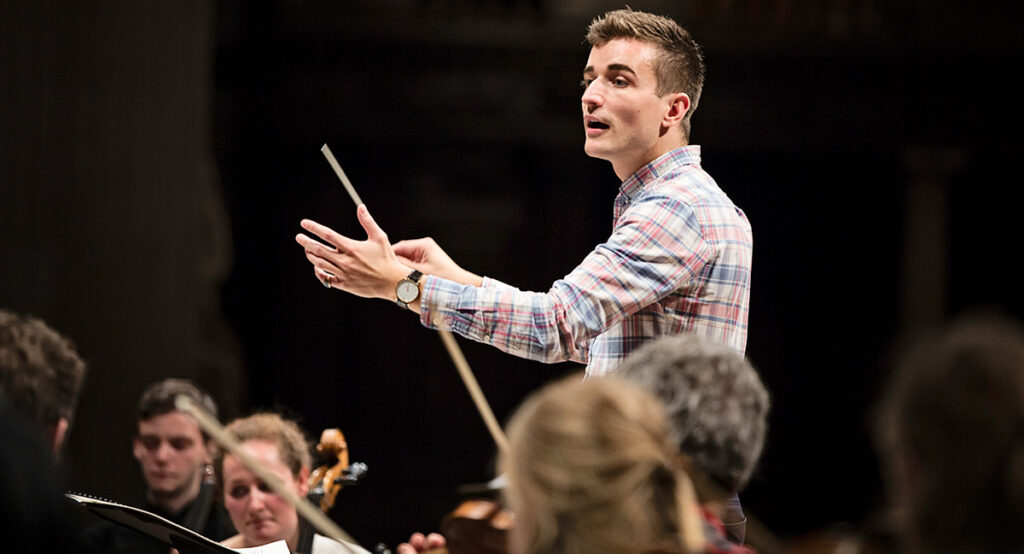
(Michael Waldron photo credit: Charlotte Machin Photography)
For more on music for virtual events and conferences, see the related post: “Music for Virtual Conferences and Events: It’s Not That Simple”