Look Your Best in Video Meetings: Lessons from TV’s News Anchors

After hosting more than a hundred thousand virtual meetings and putting 355,805 video meeting participants on camera during 2020, we at OpenExchange continue to be amazed at the fact that nearly one in five business professionals don’t know how to properly position themselves and their cameras to look their best on a video call or video presentation.
Our more than 800 video specialists do their level best to coach and cajole, but we still see more than our share of video call participants who are squished into the bottom of the frame, too close for comfort, showing more of their chin and nasal passages than their eyes, or lined up with a sight line that’s nowhere near the camera’s point of view.
And yes, it matters. After all, visual communications is not just about the words that are spoken, but it’s also about the body language, facial expressions, gestures, and even props that convey a message. And as human beings we’re conditioned to respond favorably to a properly-framed speaker who uses the full suite of visual communications tools available.
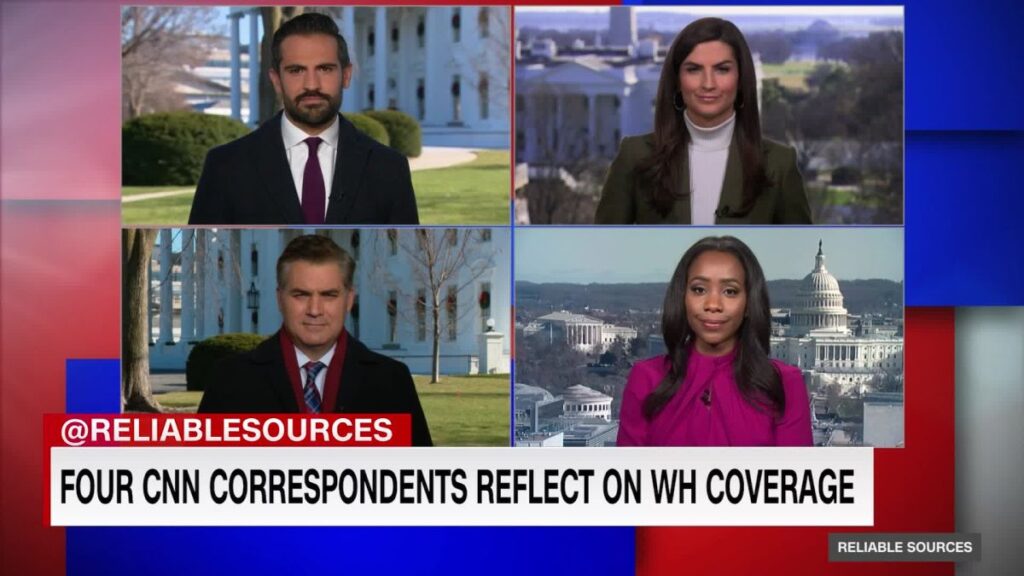
Part of that conditioning comes from watching television news anchors all our lives. More than any other professional, news presenters and their producers are practiced at the art of on-camera presentation. Take a look at these examples from some of the top news anchors. What do you notice?






Eye Level
The first thing that’s obvious is that the camera is at exactly eye level. Too often, our webcams — especially built-in cameras on our laptop computers — are looking up at us, showing a whole lot of chin and nose hairs and an unnatural amount of ceiling in the background. If you’re trying to communicate as equals in a video meeting, you should take pains to place your camera at eye level, even if it means putting some books under your laptop to lift it up.
 Eye Contact
Another thing you’ll notice is that they’re looking straight at the camera, making eye contact with you. In a video meeting or presentation, it’s important to place your camera as close as possible to the screen where you’ll be viewing other participants. And whenever possible, look at the camera lens, not the screen with the other participants. Because some built-in camera lenses are difficult to see (particularly on Macbooks), it may help to put a little sticky note with an arrow next to the camera lens as a reminder.
Headroom
A third thing to note is what’s called “headroom”. Note that in each case, the top of the anchor’s head is just slightly below the top of the frame — never touching, but also never more than 5 to 10% of the frame left empty above the crown of the head. Too often, we see heads squished unnaturally into the bottom half of the frame.
Framing
And finally, proper framing involves the amount of your body that’s showing as well. Looking again at our news anchor examples, each of them is framed so that the bottom of the frame is just below the armpits — even when they’re appearing in a multi-box with other news reporters or guests. This gives ample room for gestures and other body language cues that are part of communicating in a visual medium.
The Rule of Thirds
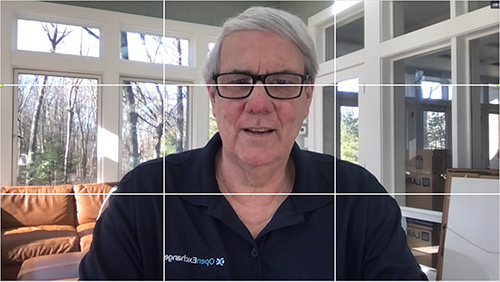
 Video producers often talk about the “rule of thirds” in composing a video frame, in which the most important elements of the picture fall on the one-third mark within the frame (see the reference image to the right). In a single-subject image like a face-forward headshot, the vertical lines are less relevant, but it’s generally agreed that the most powerful framing is achieved by placing the presenter’s eyes on the horizontal line one-third of the way down from the top of the frame, and the top of the head just below the top of the frame.
 Putting it All Together
Here’s how this applies to the way I typically frame myself for video meetings and presentations. By keeping your eyes on the one-third line, your head just below the top of the frame, and your head centered in the frame, you’ll look your best, and be in position to take full advantage of the gestures, body language, and facial expressions that are very much part of compelling communications.